Mastering Line Graphs in Four Quadrants
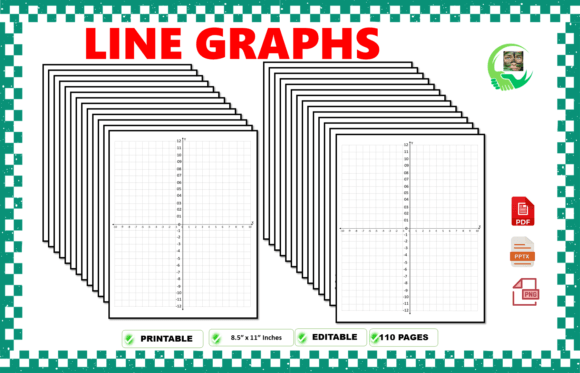
If you have ever tried to plot data that includes both positive and negative values, you have likely run into the limitations of standard graph templates. A simple two-axis chart works fine when everything sits above zero, but real-world data is rarely that tidy. That is where Mastering Line Graphs in Four Quadrants: A Comprehensive Guide steps in. This publication is a thorough resource for understanding how to build, read, and apply line graphs that extend across all four quadrants of a Cartesian plane. While it may sound technical, the book approaches the subject with everyday situations in mind, making it accessible to anyone who needs to make sense of data that goes above and below zero on both axes.
Why Four Quadrants Matter in Daily Work
Most people encounter simple line graphs in school or at work, but those graphs usually cover only the top-right quadrant. That works fine for tracking rising temperatures or monthly revenue, but what about tracking net change where values fall below zero? A financial analyst monitoring profit and loss over time needs both positive and negative territory. A marketing manager comparing campaign reach versus cost-per-click might see negative values on one axis. In both cases, confining data to a single quadrant hides half the story.
The four-quadrant setup allows you to see relationships and trends that would otherwise be invisible. For example, plotting customer satisfaction scores alongside support ticket volume can reveal whether high satisfaction correlates with high or low effort. Without the lower quadrants, you would not be able to represent scores that drop below a neutral baseline. The guide in this book walks through such scenarios step by step, showing how to choose the right scale, label quadrants clearly, and avoid misleading visual shortcuts.
Data analysts and business intelligence teams
If you work with dashboards or monthly reports, you already know that stakeholders want clarity, not clutter. A four-quadrant line graph can display two variables at once—for instance, time on the x-axis and a performance metric on the y-axis, with a zero line separating growth from decline. Mastering Line Graphs in Four Quadrants offers practical exercises that teach you to spot patterns in the noise. Instead of just showing that revenue went up, you can show where revenue growth coincided with cost reduction (upper-right movement) versus where costs rose faster (upper-left movement if costs fall on the x-axis).
One real-world example from the book involves a logistics company tracking delivery speed against customer complaints. The graph plotted average delivery time (x-axis) against complaint rate (y-axis), with zero representing the industry benchmark. By seeing which quarters fell into the “fast delivery, few complaints” quadrant, the team quickly identified best practices worth scaling. That kind of actionable insight is hard to pull from a standard line graph that only shows one variable.
Educators and trainers
Teaching data visualization often means explaining why some charts work better than others. For instructors covering statistics or business analytics, the four-quadrant line graph is a powerful teaching tool. It demonstrates relationships like positive correlation (data clustering in quadrant I or III) and negative correlation (quadrants II and IV). The guide includes sample datasets and interpretation prompts that can be used in classrooms or workshops. Instead of lecturing about abstract concepts, students can plot real numbers—such as study hours versus test scores—and see how outliers land in unexpected quadrants.
Teachers have noted that once students grasp the four-quadrant grid, they start asking better questions. Why does this point fall in quadrant II when the trend suggests it should be in quadrant I? That leads to discussions about outliers, measurement error, and context. The book supports that kind of exploration rather than just presenting rules.
Researchers in psychology, economics, and public policy
Academic research frequently deals with variables that swing above and below a baseline. Economic indicators like GDP growth can be negative during recessions. Psychological measures like mood ratings can dip below a neutral midpoint. Public health data might compare vaccination rates against disease incidence, where both axes have meaningful zero points. Researchers who use four-quadrant line graphs can present their findings in a way that immediately highlights which conditions produce desirable outcomes.
The guide covers how to handle data that does not center neatly around zero, like survey scores on a 1–5 scale. It suggests recentering around the midpoint or using normalized scores so that quadrants remain meaningful. This is one of the book’s strengths: it acknowledges that the real world is messy and offers adaptable solutions rather than rigid formulas.
Practical Examples You Can Apply Today
You do not need to be a mathematician to benefit from this approach. Consider a small business owner who tracks weekly sales and weekly ad spend. A standard graph might show both lines over time, but it is hard to see the relationship directly. Instead, create a four-quadrant graph with ad spend on the x-axis and sales on the y-axis, both centered around your historical averages. Each week becomes a point. Weeks where sales exceeded the average while spending stayed below average fall in quadrant II (high return). Weeks with high spend but low sales fall in quadrant IV (low return). The line connecting weeks in chronological order shows whether the relationship is improving or deteriorating over time. This technique is detailed in the guide, along with tips for choosing the right baseline and avoiding visual clutter when many data points overlap.
Another scenario: a product manager comparing feature usage against user satisfaction. By plotting usage frequency (x) against satisfaction score (y), you can segment features into four types: beloved mainstays (high usage, high satisfaction), underappreciated gems (low usage, high satisfaction), workhorses (high usage, low satisfaction), and neglected problems (low usage, low satisfaction). The line graph adds a time dimension, showing whether a feature is moving from one quadrant to another after updates. The book includes a case study from a SaaS company that applied this method to prioritize their roadmap, cutting low-satisfaction features with low usage and doubling down on underappreciated gems.
Common Considerations Before You Dive In
While four-quadrant line graphs are versatile, they are not a universal solution. One limitation is that they can become difficult to read when too many data points are plotted over a long period. The guide advises using transparent markers or only plotting a subset of data for presentation purposes. Another consideration is the choice of center point. If your data has a natural zero (like profit), that is clear. But if your data is relative (like satisfaction on a scale from 1 to 10), you either need to choose a meaningful midpoint or shift the data so that zero represents a neutral value. The book covers both approaches with examples so you can decide what makes sense for your audience.
A strength of the guide is its emphasis on labeling. Many people forget that quadrant labels (I, II, III, IV) are not intuitive to everyone. The author suggests using descriptive labels like “High growth / High cost” or “Low performance / Low effort” instead of relying solely on quadrant numbers. This is especially important when presenting to non-technical stakeholders who may not be familiar with Cartesian conventions.
Another point worth noting is that not every dataset gains from four-quadrant treatment. If your data rarely crosses zero on either axis, a standard single-quadrant graph will be simpler and just as effective. Mastering Line Graphs in Four Quadrants acknowledges this early on, helping readers avoid overcomplicating simple comparisons. That kind of practicality keeps the book from feeling like a one-size-fits-all manual.
How Different Users Find Their Own Path
What makes this guide stand out is how it respects different entry points. A student might start with the basics: how to construct a line graph manually or in software. The book includes exercises that use common tools like Excel and Google Sheets, with screenshots that show how to set up a chart with four visible grid quadrants. A professional who already knows the basics can jump ahead to the chapters on interpretation and storytelling. There is a section on “flipping quadrants” to avoid misinterpretation—for instance, reversing the x-axis for time series data so that the most recent data appears on the right.
For creative professionals, like user experience researchers, the guide offers examples of empathy mapping and journey mapping where emotional valence can be plotted against time or effort. Seeing how a user’s experience shifts from positive to negative and back again during a task can reveal friction points. That kind of application bridges data visualization with human-centered design.
One reader, a project manager in construction, shared how she used the book’s principles to track safety incidents against project timeline pressure. She plotted weeks (x-axis) against incident severity (y-axis, where zero is the industry average). When pressure spiked due to deadlines, incidents often climbed into quadrant IV (high pressure, high severity). Presenting that graph to leadership made the case for adjusting schedules more effectively than any spreadsheet could.
Strengths and Limitations at a Glance
The biggest strength of Mastering Line Graphs in Four Quadrants: A Comprehensive Guide is its ability to turn a potentially dry subject into a practical tool for decision-making. It avoids heavy theory and spends most of its pages on real-world applications. The exercises are short enough to complete in a coffee break but insightful enough to shift how you think about data. A potential limitation is that the book assumes some familiarity with basic graphing concepts. Complete beginners might need to supplement with a primer on chart types. Additionally, because the guide focuses on line graphs, it does not cover scatter plots or area charts in depth, even though those can also benefit from a four-quadrant layout. That said, the principles transfer easily, and the author points out when a different chart type might serve better.
Another limitation worth considering: the data preparation required for four-quadrant graphs can be more time-consuming upfront. You may need to calculate baselines, normalize variables, or convert scales. The book acknowledges this and suggests using spreadsheet formulas to automate part of the process. For teams that create recurring reports, the investment in setup pays off quickly when the resulting visual clarity saves time in meetings.
In the end, whether you are a data professional, a manager, a researcher, or a student, the ability to represent information across all four quadrants adds nuance to your analysis. This guide provides a structured way to develop that skill, with plenty of room to adapt the methods to your own context. It is not a dry textbook—it is a hands-on companion for anyone who has ever stared at a simple line graph and wished it could tell a fuller story.