Mastering Diagonal Sudoku with the 2,000 Puzzle Collection
The Unique Appeal of Diagonal Sudoku
Sudoku X, also known as diagonal Sudoku, introduces a compelling twist to the classic puzzle by adding two additional constraints. In standard Sudoku, players fill a 9x9 grid so that each row, column, and 3x3 box contains the digits 1 through 9 exactly once. Diagonal Sudoku extends this rule by requiring that the two main diagonals—from top-left to bottom-right and from top-right to bottom-left—also contain each digit exactly once. This seemingly small addition transforms the solving experience, demanding a deeper level of spatial reasoning and foresight. For many puzzlers, the 2,000 Diagonal Sudoku set offers a rich journey through this variant, with each puzzle presenting unique patterns and logical chains.
How Diagonal Constraints Deepen Strategic Play
The diagonal requirement acts as a natural guide for placement. When a digit is placed on a diagonal, it simultaneously affects four domains: the row, column, box, and the diagonal itself. This interdependence forces solvers to consider multiple layers of elimination. For example, in an easy puzzle, a player might quickly identify a single possible cell for a digit by scanning only rows and columns. With diagonal Sudoku, the same step often requires checking whether that digit already appears on the diagonal. This extra check slows down mechanical solving and encourages a more holistic view of the grid. Over the course of 500 easy puzzles in the 2,000 Diagonal Sudoku volume, beginners can internalize this habit before moving to harder levels.
Medium puzzles introduce interactions where diagonal constraints clash with box constraints, requiring trial and error or advanced techniques like naked pairs. Hard and extreme puzzles escalate this further, often forcing solvers to use notation and iterative logic. The extreme level, in particular, mimics the challenge of tournament-level diagonal Sudoku, where every move must be justified by multiple constraints. This progressive difficulty structure in the 2,000 Diagonal Sudoku collection allows solvers to build stamina and confidence without feeling overwhelmed.
Inside the 2,000 Diagonal Sudoku Volume 1
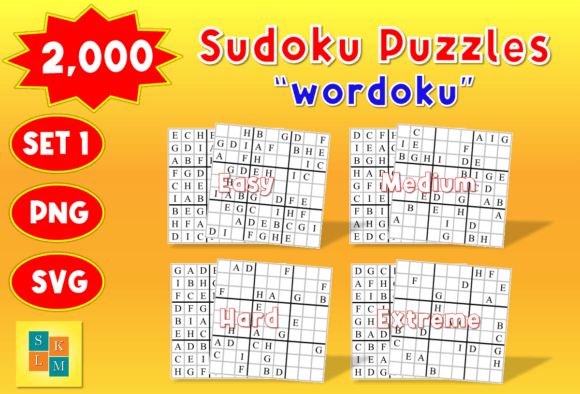
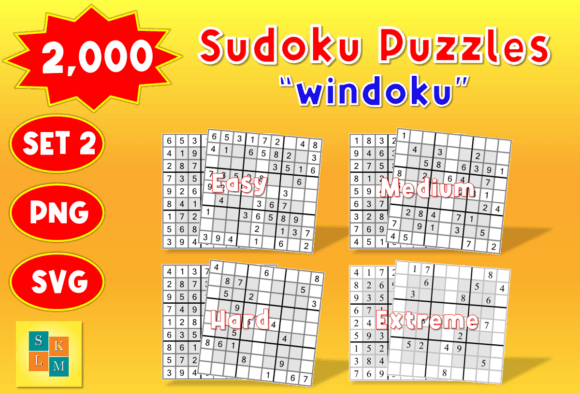
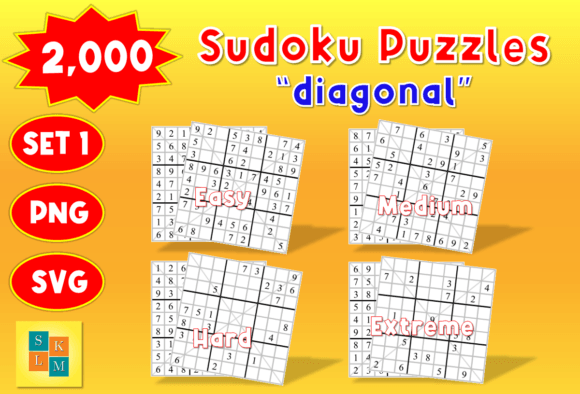
This volume contains exactly 2,000 puzzles, evenly split across four difficulty levels: easy, medium, hard, and extreme—500 each. The puzzles are 9x9 grids, and each comes with its solution. What sets this product apart is the inclusion of both PNG and SVG file formats for every puzzle and solution. PNG is ideal for quick printing or digital display, while SVG offers scalability without loss of quality, making it perfect for professional publishing or custom resizing. The files are organized in a zipped folder, which also contains a note about the program used to create the puzzle books.
Four Levels of Difficulty for Progressive Skill Building
The easy puzzles in this 2,000 Diagonal Sudoku set typically have more given digits and straightforward diagonal interactions. They are designed for new solvers who are learning the diagonal rule or for casual relaxation. Medium puzzles reduce the number of givens and introduce scenarios where the diagonal constraint breaks symmetry—for instance, when a digit on one diagonal forces a chain of eliminations on the other. Hard puzzles require active use of pencil marks and advanced techniques such as X-wing or swordfish, adapted for diagonals. Extreme puzzles push the envelope, often with minimal givens and interlocking diagonal patterns that demand careful backtracking. This graduated system ensures that solvers can measure their improvement across the 2,000 puzzles.
For puzzle publishers, this variety means they can select specific levels for targeted audiences. A book aimed at beginners might draw exclusively from the easy and medium sets, while a compilation for enthusiasts could mix hard and extreme puzzles. The 2,000 Diagonal Sudoku volume provides a ready-made library that eliminates the need to generate puzzles independently.
Complete Solutions with Dual File Formats
Each puzzle has a corresponding solution file, formatted identically in PNG and SVG. This pairing is invaluable for self-checking and for publishers who want to include answer keys in their books. The PNG solutions are raster images that can be inserted directly into PDFs or web pages, while the SVG solutions are vector-based, allowing them to be edited or embedded in responsive layouts. Offering both formats acknowledges that users have different workflows—some prefer quick access via PNG, while others need the flexibility of SVG for design modifications. The zipped file structure keeps puzzles and solutions together, making it easy to locate any specific grid.
Practical Applications for Different Users
The 2,000 Diagonal Sudoku collection is versatile enough to serve a broad audience. Its design balances completeness with adaptability, whether for personal use or commercial projects.
For Puzzle Publishers and Creators
Publishers can use these puzzles to build a full-length book or a variety of puzzle books. Since the collection includes 2,000 unique grids, a single volume can fill multiple books when combined with other puzzle types from the same store or from the publisher's original creations. The SVG files are particularly beneficial for professional layout, as they can be scaled to any page size without pixelation. The attached note about the puzzle creation program also provides transparency—publishers can understand the methodology behind the puzzles, which supports quality assurance. For instance, a publisher might create a book with 200 easy diagonal Sudoku, 200 medium, and 100 hard, using the PNG files for quick compilation and the SVG files for any custom framing.
For Educators and Researchers
Educators can use diagonal Sudoku to teach logical deduction and pattern recognition. The 2,000 Diagonal Sudoku set offers enough material for a semester-long course, with each difficulty level serving as a milestone. Researchers studying human problem-solving or AI constraint satisfaction can replicate experiments using these puzzles, knowing that the diagonal rule adds a controlled variable. The consistent 9x9 format across all levels simplifies data collection, and the dual file formats allow for digital processing of puzzle states.
For Hobbyists and Enthusiasts
Individual solvers benefit from the sheer volume—2,000 puzzles provide months of engagement. The extreme level, in particular, appeals to those who crave a brain workout. A hobbyist might print all extreme puzzles using the PNG files and solve them over weekends, tracking completion times. The SVG files allow tech-savvy users to load puzzles into apps or online solvers that support vector graphics. The inclusion of solutions means that when a solver gets stuck, they can check a specific step without waiting for external help.
Leveraging the Attached Note and Zipped Program
The zipped file includes a note about the program used to create the puzzle books. This note is not a full software tool but rather documentation or a script reference that reveals the generation process. For creators interested in customizing puzzles—such as adjusting the density of givens or generating grids with specific diagonal patterns—this note provides a starting point. It might describe parameters used for the difficulty levels, ensuring that the puzzles in the 2,000 Diagonal Sudoku volume are consistent in quality.
Streamlining Puzzle Book Creation
Puzzle book creation often involves tedious layout work. With this product, the hard part is already done: puzzles and solutions are separated, named systematically, and available in two formats. The note can help users automate further steps, such as batch resizing SVG files or converting PNGs to other formats. For example, a publisher might write a script that reads the SVG files, adds borders, and combines them into a single PDF for printing. The 2,000 Diagonal Sudoku collection essentially serves as a content library that accelerates the production cycle.
Quality and Considerations for Use
Each puzzle in the 2,000 Diagonal Sudoku set is guaranteed to have a unique solution, a standard requirement for logical sudoku. The diagonal constraint is applied correctly, meaning no repeated digits on either main diagonal. The difficulty levels are balanced: easy puzzles have many givens and short solution paths, while extreme puzzles require deep inference. One consideration for users is file management—while the zipped folder is organized, handling 2,000 pairs of files can be overwhelming without proper naming conventions. The filenames likely include puzzle ID and level, which helps. Another point is that the PNG files are raster, so they have fixed resolution; for very large prints, SVG is preferable.
For those combining these puzzles with other types—such as standard Sudoku or killer Sudoku—the 2,000 Diagonal Sudoku volume provides a consistent theme. Publishers can create themed books like "Diagonal Sudoku for Experts" or mix levels for variety. The dual format ensures compatibility with both traditional print and digital platforms, including tablets and e-readers.
In practice, a user might start with an easy PNG puzzle to get comfortable with the diagonal rule, then progress to medium SVG puzzles for scalable practice. The solutions remain accessible in both formats, allowing for immediate feedback. Over time, the 2,000 puzzles represent a gradual mastery path that reinforces the unique logic of diagonal Sudoku without becoming repetitive.